
What a 24-Hour Backyard Ultra Can Teach Your Health and Movement Science Students
Oct 28, 2026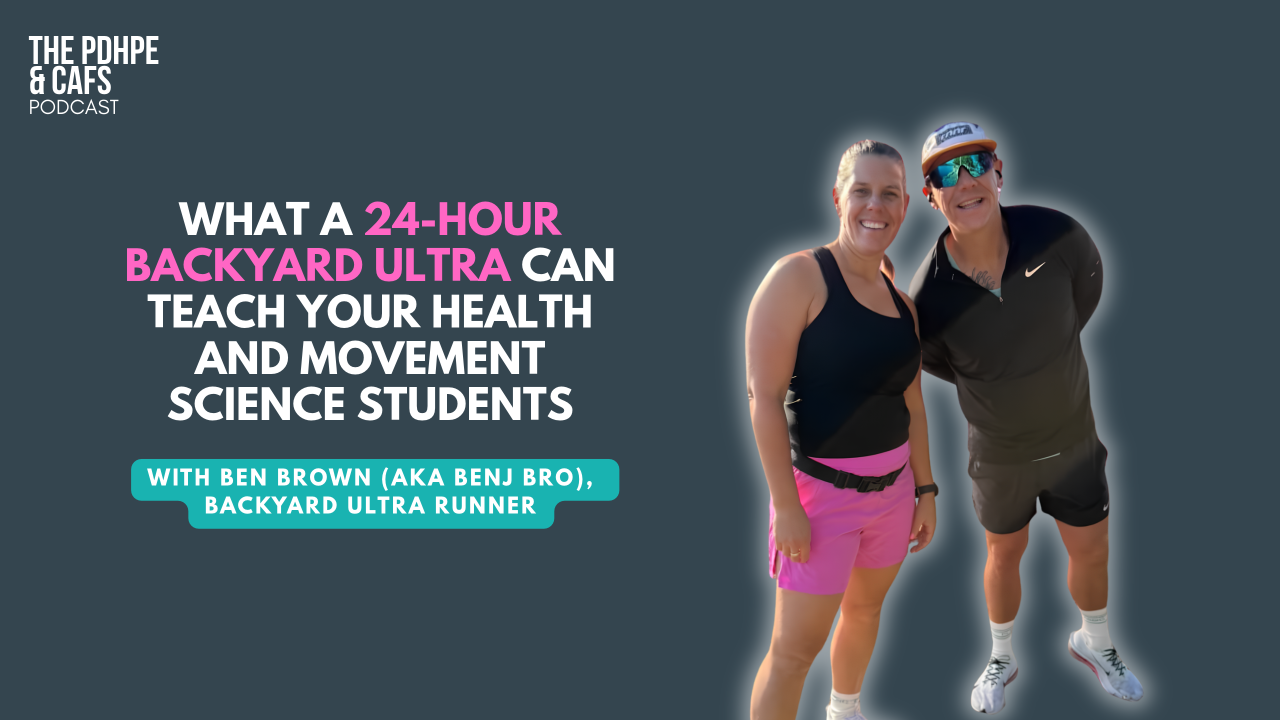
Every hour, on the hour, runners line up and run 6.7 kilometres. Finish the lap inside the hour and you go again. Miss the cut-off and you're out.
That's a backyard ultra. In September, my brother Ben Brown ran 24 laps. That's 160 kilometres, or 100 miles.
A year ago, Ben wasn't a runner. He started running to get his daily steps up and ended up running 180 days straight.
What fascinated me most wasn't the distance. It was why he stopped.
His lap times were steady. His second last lap was one of his fastest of the race. His body had more to give. His brain had already decided he was done.
For Health and Movement Science teachers, that's psychology, nutrition and training in one story your HMS students won't forget.
1. The mind decides before the body does
Ben reckons 80% of a backyard ultra is mental.
He went in with a goal of 24 hours. The moment he reached it, he started the next lap, walked to the end of the corral and turned around. His coach had warned him: don't go into a backyard ultra with a goal, because when you hit it, your brain switches off.
He also experienced phantom pain. Just after he hit 100 kilometres, his knee started throbbing and he messaged his crew to say he was done. They strapped it. The tape peeled off within 100 metres, he threw it in the bin and within two minutes the pain was gone.
Use it with your Health and Movement Science students:
- Ask why so many runners stopped at exactly 100 kilometres.
- Compare outcome goals with process goals using Ben's 24-hour target.
- Discuss how self-talk and fatigue shaped Ben's decision to stop.
- Share his steady 45 to 47 minute laps and ask where the physical limit actually showed up.
2. Fuelling is something you train
We grew up being told to wait half an hour after eating before we played. Ultra runners do the opposite.
Ben trained his gut on long runs. A banana, then run. A ham and cheese sandwich, then run. Two gels, then run. On race day he carried a carbohydrate drink on every lap and ate between laps, aiming for 60 to 90 grams of carbohydrates an hour, a target he set with a sports nutritionist.
Now compare that with our dad. At 70, he completed a half Ironman: a 1.9 kilometre swim, a 90 kilometre bike ride and a 21.1 kilometre run. He fuelled it with a banana, half a Vegemite sandwich, a few lollies and one gel. Partway through the run, he said he felt depleted.
Use it with your HMS students:
- Calculate how much carbohydrate Dad needed across a seven-hour event.
- Link "feeling depleted" to glycogen stores and carbohydrate intake.
- Compare an everyday athlete's fuelling with an elite triathlete's.
- Discuss why gut training belongs in the preparation phase.
Real athletes make Health and Movement Science stick
Ben isn't elite. He works nine to five, trained at night and fitted in double sessions before and after work. That's exactly why Health and Movement Science students connect with his story.
🎧 Listen to Episode #193 of The PDHPE & CAFS Podcast: thelearnnet.com/193
And if you'd love HMS resources, assessment support and a community of teachers who understand the work you're doing, come and join The Health and Movement Science Membership. thelearnnet.com/hms
