Teaching Sex Ed in 7-10 PDHPE with Clarity and Confidence
Jul 15, 2026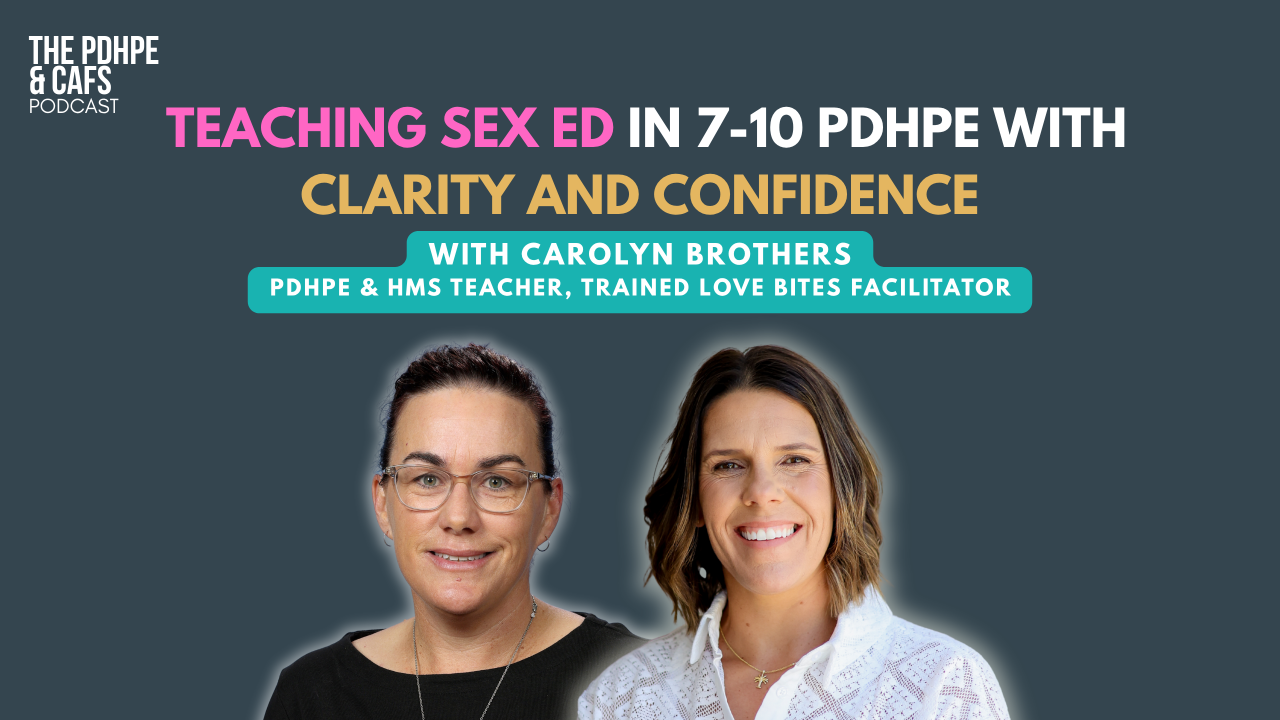
Let me ask you something. When did you last feel completely confident teaching sex ed?
If you had to think about it, you are in good company. Teaching sexual health and respectful relationships is one of the trickiest parts of NSW 7-10 PDHPE. The content shifts. The students change. And most of us are trying to teach it without feeling fully up to date on what best practice actually looks like right now.
This week on The PDHPE & CAFS Podcast, I sat down with Carolyn, a PDHPE & Health and Movement Science teacher who is also a trained Love Bites facilitator. Here is what stood out.
Our students are arriving with more, earlier
Carolyn said it plainly. Young people are exposed to images and experiences like nothing we have seen before. Kids are stumbling across things online younger than ever and that shows up in the questions they ask in our rooms.
That is not a reason to shy away from the content. It is the reason we lean in. Our students need us to be the steady, informed voice in the room.
- Start with the syllabus, not a chat
- Moving from having a conversation to explicit skill-building
- Look at the framing and the outcomes. What skills am I building?
- Identifying respectful relationships. Reading a scenario for what is off
- Critical thinking under real-world pressure
When you teach the skills explicitly, the learning sticks in a way a one-off chat never will.
- Teach in a trauma-informed way
- In any given class, you may have students who have lived experience
- This does not mean we avoid the topic. It means we teach it with care
- Be age-appropriate. Engage with facts and current data. Know your statistics on sexual violence.
- Build in the time to unpack and debrief, so no student is left carrying something alone after the bell.
- You matter more than any one-off day
- The research is clear. It is the teacher who connects most with students and brings these conversations to life.
- You are the coach, the year advisor, the one they trust
- Respectful relationships teaching lands harder coming from you than from a single visiting session.
- External programs add value. They do not replace you.
A free resource worth knowing about: Love Bites
Carolyn is passionate about Love Bites, run through NAPCAN, and after this chat I understand why. It is fully funded, so it costs your school nothing. It is mapped to the curriculum with explicit outcomes and content points. And it brings trained community facilitators, from social workers to health professionals, into your school as a different voice in the room.
It covers respectful relationships, gender stereotypes, abuse in relationships, sex and consent, and speaking up and advocacy. Carolyn also uses Run Against Violence as a Health and Movement Science depth study, a brilliant real-world example of collective action your Health and Movement students can analyse.
You can look at the program here: https://www.napcan.org.au/programs/love-bites/.
There is a great intro video here: https://www.youtube.com/watch?v=jJuHYnMfT28.
And you can register interest in having it delivered at your school here: https://napcan-lovebites.rosterfy.com.au/invite/wbtiwgbghw6QyAAPY7maLOViUb2hwmonY9SpTZLprhQ9lZA8Na8t6j6xkhEE.
Where to from here
- If this is an area you have been avoiding, start small
- Have the faculty conversation. Look at your scope and sequence
- Get one solid unit right before you add anything external on top.
Listen to the full episode with Carolyn at thelearnnet.com/180.
And if you want done-for-you 7-10 PDHPE resources so respectful relationships teaching is planned, sequenced and ready to go, come join us in the 7-10 PDHPE Membership at thelearnnet.com/secondary.
