Teaching Adoption in Community and Family Studies
Sep 23, 2026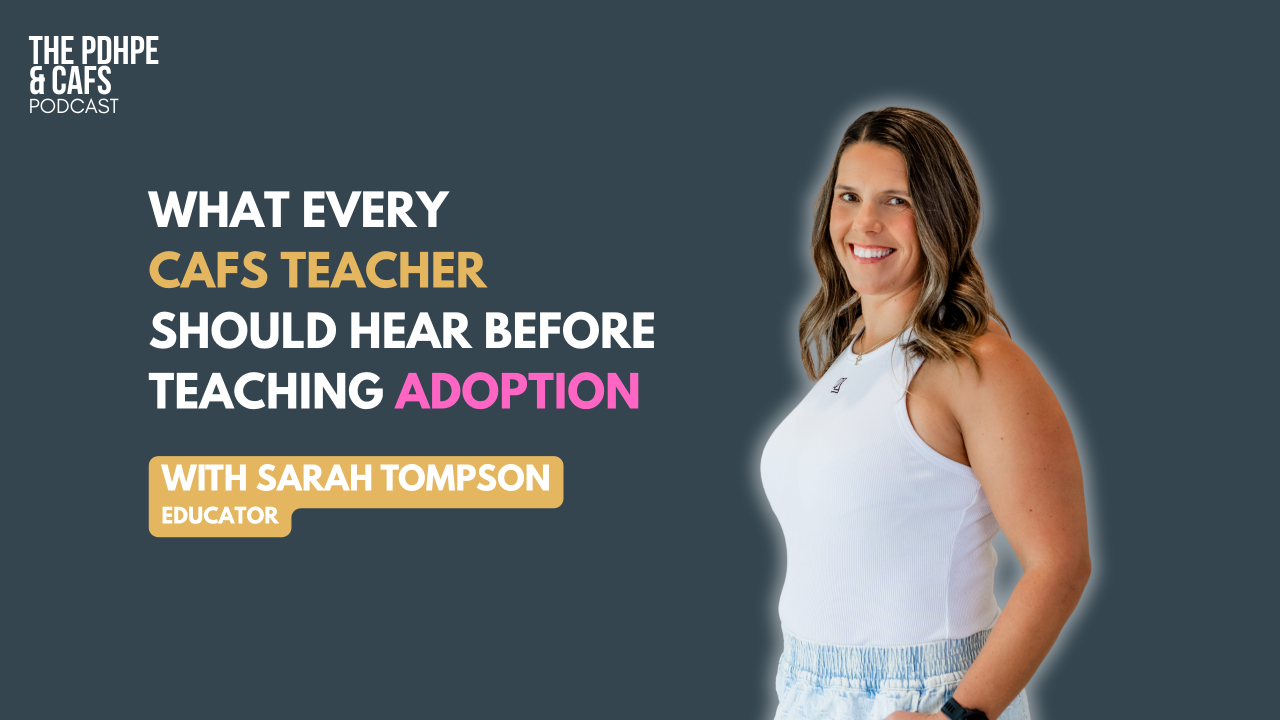
If you teach Community and Family Studies, you know there is a lot of content to get through. It can be easy to fall into the pattern of teaching the content, working through the syllabus dot points, giving our students an example and moving on to the next thing.
This week on The PDHPE & CAFS Podcast, I sat down with Sarah Tompson, a NSW educator of almost 20 years who was born in Papua New Guinea and adopted by an Australian family at three weeks old.
Sarah was recently invited by a CAFS teacher to share her story with two Year 12 Community and Family Studies classes. When I heard about it, I knew this was a conversation we needed to have on the podcast because it is exactly what I mean when I talk about bringing CAFS to life.
There is only so much our students can learn from a textbook
I actually wrote the Parenting and Caring chapter of the Community and Family Studies textbook about 13 years ago, so I know the content we teach our CAFS students around adoption, fostering, surrogacy and step-parenting.
But my conversation with Sarah was such a good reminder that there is only so much our students can learn from a textbook.
We can teach the definition of adoption, unpack the syllabus content and give students examples. But hearing from someone who has actually experienced adoption brings a completely different perspective into the CAFS classroom.
Sarah spoke about her birth father walking for three days to reach the nearest hospital and the decisions that were made about her future when she was only weeks old. She also talked about growing up in Australia, her relationship with identity and culture, and the experience of having to explain her family to other people.
These are the stories that help students understand the people behind the syllabus content. For our Community and Family Studies students, that matters.
Think about the activities we use when teaching family
One part of our conversation that really stayed with me was Sarah’s experience of completing a family tree activity when she was at school.
She had nothing to write.
Sarah is now a teacher herself and it is an activity she chooses not to use. That made me think about how easily we can continue using activities because they have always been part of a unit without stopping to ask what that activity might be like for the students sitting in front of us.
We don’t always know what our students have experienced outside the classroom, and sometimes a small change to an activity can make it much more inclusive without changing the learning intention at all.
The language we use matters
Sarah and I also talked about the term “social parenting”, which is used in the CAFS syllabus when we teach adoption, fostering, surrogacy and step-parenting.
We can teach that terminology while also acknowledging that the language used in a syllabus document may not be the language a person uses to describe their own family or lived experience.
Bring CAFS to life through real stories
I talk about this a lot because I really believe in it.
Our CAFS students shouldn’t spend every lesson copying notes from the board, reading a textbook or clicking through another Google Slide. We want them to understand the content, apply it and see how it connects to the world outside the classroom.
Guest speakers are one way we can do that. So are case studies, community organisations, current examples and stories like Sarah’s.
Our students need specific, relevant and applied examples they can draw on rather than generic examples they have memorised from a textbook.
Community and Family Studies goes beyond the classroom
Community and Family Studies is about people, families, communities, relationships, resources and wellbeing. Our students are surrounded by examples every day, and we have so many opportunities to bring those examples into our teaching.
If you are teaching CAFS and the Parenting and Caring content, particularly adoption, pop this episode in your ears before your next lesson. It will give you plenty to think about, but more importantly, it will give you some practical ideas about how you can bring lived experience into your own CAFS classroom.
🎧 Listen to Episode #190: thelearnnet.com/190
And if you are the only Community and Family Studies teacher at your school, or you simply want more CAFS resources, ideas and support, come and join us inside The CAFS Collective.
