Beyond Scare Tactics: Evidence-Based Vaping Prevention for 7-10 PDHPE Teachers
Jun 10, 2026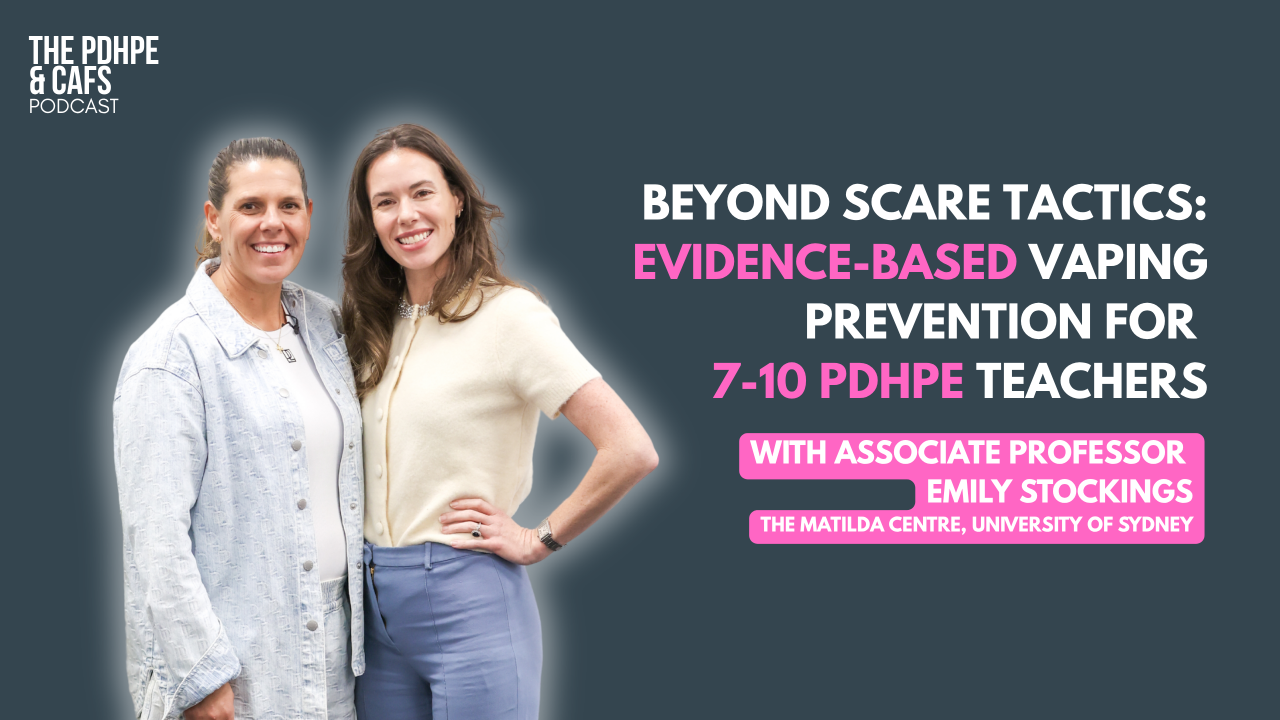
You are not a drug researcher. You are not a public health scientist. You are a 7-10 PDHPE teacher with a Stage 4 or 5 class in front of you and a drug education unit coming up in your program.
So what do you actually need to know about vaping? And what can you do that will make a real difference?
We sat down with Associate Professor Emily Stockings from the University of Sydney's Matilda Centre for Research in Mental Health and Substance Use. Emily has spent years researching nicotine dependence and designing vaping prevention programs for schools. Here is what she wants every PDHPE teacher to know.
Why vaping exploded in NSW schools after COVID
Before COVID, vaping was on the radar but not yet embedded in Australian schools. Then the pandemic hit. Border resources were redirected. Imports from large Chinese manufacturers flooded in. A legal loophole allowed vapes to be sold as long as they did not claim to contain nicotine, even when they did.
At the same time, young people were at home, bored, isolated and looking for something. By the time Australia emerged from COVID, vapes were everywhere. The 2023 vaping reform bill has since closed the loophole, but the supply chain is well established and enforcement is struggling to keep up.
Why scare tactics don't work with your Stage 4 and 5 students
The consequences of vaping are almost invisible to young people.Compare that to alcohol. Young people are increasingly choosing not to drink because they know how awful they feel the next day. The consequence is immediate and tangible. With vaping, the damage happens slowly and silently inside an adolescent brain that is still forming and young people have no frame of reference for that.
That is why simply telling them it is bad for them does not land in your Year 8 or Year 9 classroom. You cannot scare someone away from a consequence they cannot feel.
What actually works: three things you can do right now
Emily is clear that PDHPE teachers are not expected to be the experts. But there are practical things you can do directly within your 7-10 program.
Start with curiosity, not a lecture. Ask your students what they already know. Open-ended questions like "tell me what you know about vaping" hand the reins over to them and give you a genuine picture of their perceptions and misunderstandings. From there you can gently correct misconceptions or better still, turn it into a critical inquiry task that connects directly to your PDHPE outcomes.
Use role play to build real skills. Put students in situations where one person has to resist pressure and one person has to apply it. The goal is not a scripted response. It is the actual skill of saying "no thanks, not for me, but you do you" in a way that lets them hold their social standing and their decision at the same time. This is exactly the kind of decision-making and communication skill your 7-10 PDHPE program is designed to develop.
Get them angry about being manipulated. These companies are designing products to hook young people. Young people respond to that when you name it directly. They do not want to be part of someone else's profit margin. Lighting that fire is one of the most powerful things you can do in a PDHPE classroom.
The question that changes everything
At the K-10 PDHPE Forum, former Olympian Libby Trickett asked the room: what adventures do you want your body to have?
That question matters. We are educating young people for a long life, possibly into their nineties and beyond. The choices they make now will determine the quality of that life. Not just whether they survive it, but whether they get to show up fully for it.
That is not a scare tactic. That is hope. And it sits right at the heart of what great PDHPE teaching does.
The free program your faculty should know about
The Our Futures Vaping Prevention program for Years 7 and 8 is available right now at no cost through the Our Futures Institute. It is fully online, uses a cartoon-based format following young people navigating real social pressure, and has already reached over 1,000 Australian schools.
If you teach Stage 4, this is worth looking at today: ourfuturesinstitute.org.au
A primary school version is in development with a pilot currently underway.
Listen to the full conversation with Emily at thelearnnet.com/175.
