
Anxiety and Performance in Health and Movement Science
Aug 26, 2026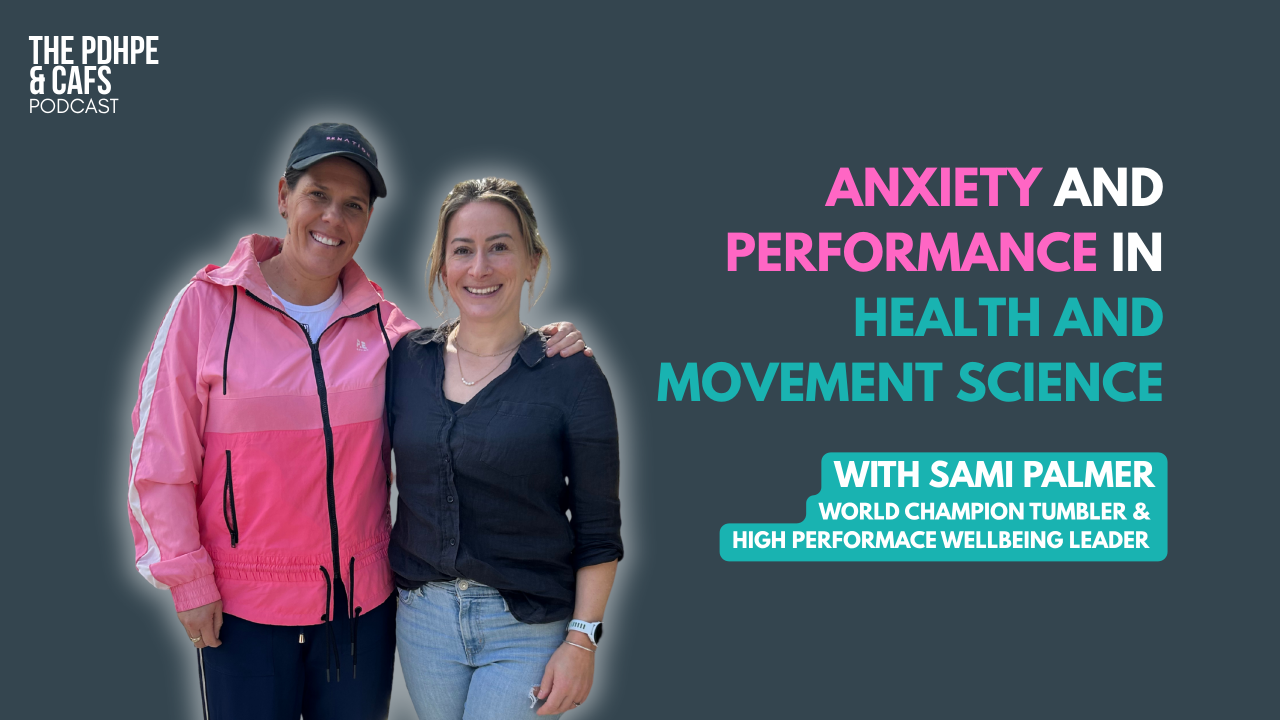
Your students can define arousal. They can define anxiety. They can tell you what the inverted U hypothesis shows. Then a question asks them to apply it to an athlete in a scenario and the marks fall away.
That is not a content problem. It is an application problem. And it is a hard one to fix when the only examples you have in front of you are the ones printed in the textbook.
This week on The PDHPE & CAFS Podcast I sat down with Sami Palmer, a world champion tumbler who competed for Great Britain at her first World Championships five days after her twelfth birthday. She now works in performance wellbeing with Australian Athletics.
What she gave me was an hour of applied examples. The kind you can build a lesson around.
Pressure does not look the same in every student
The first thing Sami said was that everyone feels pressure differently. Her teammates put headphones on to settle themselves. Music did nothing for her. When her nerves peaked she talked, constantly, about nothing in particular.
So the team gave her someone to talk at. A coach who followed her from breakfast through to the end of the competition, because that was the strategy that actually worked for her.
Neutral self-talk, not positive self-talk
This is the part that surprised me most.
Sami never went into a competition telling herself she was going to win. Not once. Not a personal best, not a score, nothing.
Her reasoning is sharp. If you set yourself a benchmark and you do not hit it, you have handed yourself a failure mid competition. The domino effect starts and the rest of the routine goes with it.
So her self-talk was factual. I have chalked my hands. My feet are grounded. I know what to do. I have done this hundreds of times.
The same logic applies to mental rehearsal. She visualised her routine once, then stopped. Any more than that and she started unpicking the individual skills, which took her straight into what if I forget.
How to teach it:
- Contrast positive and neutral self-talk side by side and ask students to evaluate the risk in each
- Have students write an anchor sentence for an athlete in a given scenario
- Teach mental rehearsal with its limits attached, not as an unlimited good
- Link self-talk back to arousal levels and where an athlete sits on the inverted U
The classroom link
Sami also talked about grounding tools. One or two words on a competition card. Naming five things you can see, because you cannot feel fear and catalogue your surroundings at the same time.
And she explained the amygdala in a way your students will remember. It cannot tell the difference between the fear of failing in front of a judge and being chased by a lion. Same signal, different context.
That is your bridge from the physiological response straight into the psychological strategy.
Next steps
Listen to the full episode here: thelearnnet.com/186
For Health and Movement Science resources that match the depth of the course, join us inside The HMS Membership: thelearnnet.com/hms
Part two lands next week, where Sami walks through the 2006 World Cup final and two World Cups two weeks apart with completely different results.
